Porto Santo to Santa Marta
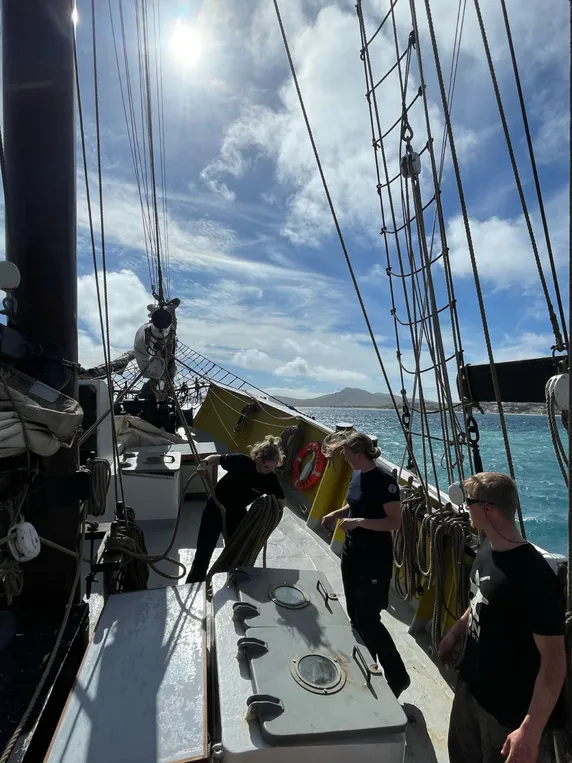
The last crates come aboard at Porto Santo: fresh produce, water, stores enough for weeks at sea. Lines are coiled, sails made ready, and the island’s hills slide astern as Ide Min stands out into open water. It is March 2025, and the course ahead runs west and then south-west, straight through to Santa Marta on the Caribbean coast of Colombia. There will be no stop on the way.
A few days out, the ship finds the northeast trades, the same wind that has carried square-rig and schooner alike across this ocean for centuries. The engine stays silent. Under working sail, Ide Min settles into the steady, rolling rhythm of a trade-wind passage: watches change, the wake runs white and constant off the quarter, and for days at a stretch the horizon holds nothing but water.
There is no shortcut across an ocean under sail. The crossing takes weeks, not days, and the crew lives by it: cooking, standing watch, mending what needs mending, reading in whatever shade the sails allow. The provisions loaded at Porto Santo are eaten down, course by course, as the miles pass. Landfall, when it comes, is not an island. It is the mainland: the mountains of the Sierra Nevada de Santa Marta rising out of the haze ahead, the highest coastal range in the world, long before the coast itself can be seen. Then the shelter of the bay, and Santa Marta.
It is one of the oldest ways to move cargo across the Atlantic, and among the slowest. It is also, for the length of the passage, a crossing made under sail, carried the whole way by the same wind that has always blown here, in the same direction, in the same season.
Ready to put your product in the next story?
Book an intro call with Huib.
Book an intro callor email info@kaapkargo.com